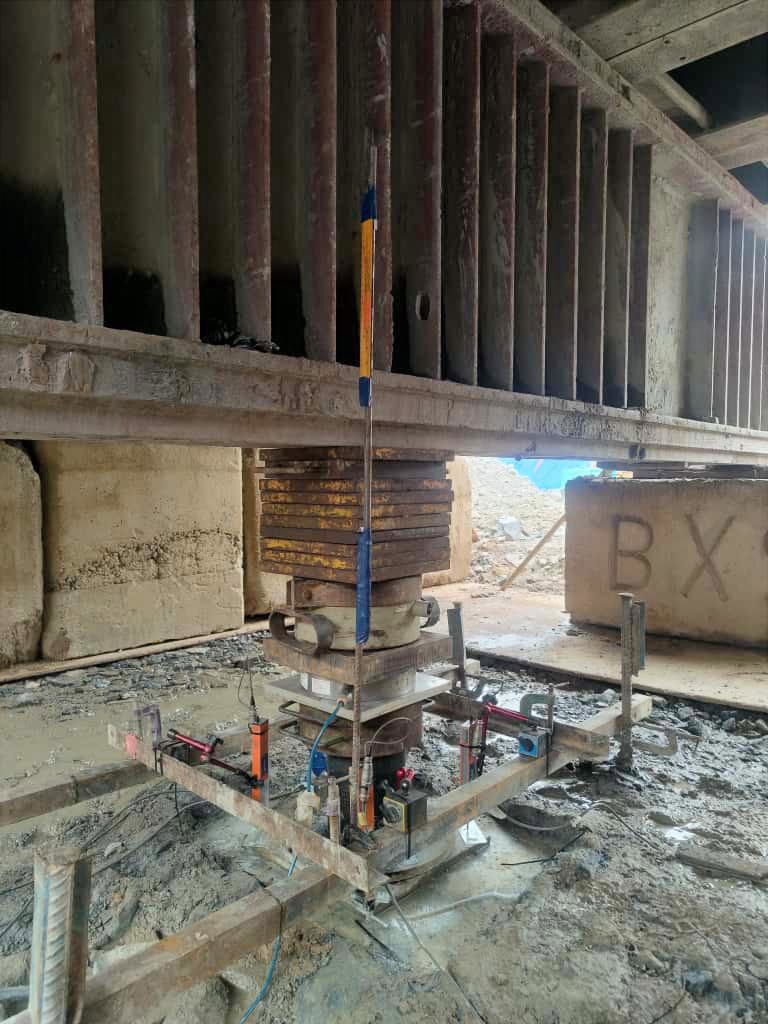
Plate Load Test (PLT)
Plate Load Testing (PLT) is a critical in-situ investigation performed to determine the ultimate bearing capacity and settlement characteristics of soil. By simulating real-world foundation conditions, the test provides empirical data on how the ground will behave under a specific structural load.
While primarily utilized for shallow foundations, PLT is also an essential tool for:
-
Verifying subgrade reactions for floor slabs and pavements.
-
Assessing the end-bearing capacity of deep foundation systems (such as caissons or large-diameter piles).
-
Evaluating the stiffness of stabilized or improved ground.
Testing Principles
The test involves placing a high-strength, rigid steel plate at the foundation’s design level. A controlled load is applied to the plate, and the resulting displacement is recorded to establish a direct stress-strain relationship for the soil.
The Loading Process
-
Preparation: The test surface is leveled and prepared to ensure uniform contact with the plate.
-
Incremental Loading: A hydraulic jack applies the load in predetermined increments (typically 1/5th to 1/10th of the estimated ultimate load).
-
Measurement: High-precision linear voltage displacement transducers monitor the settlement of the plate until it stabilizes at each increment.