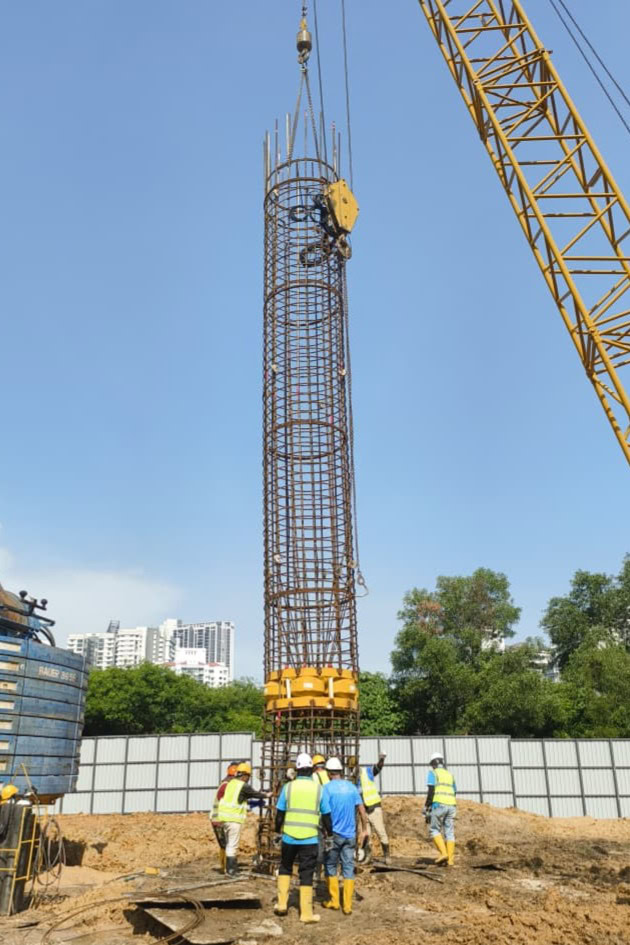
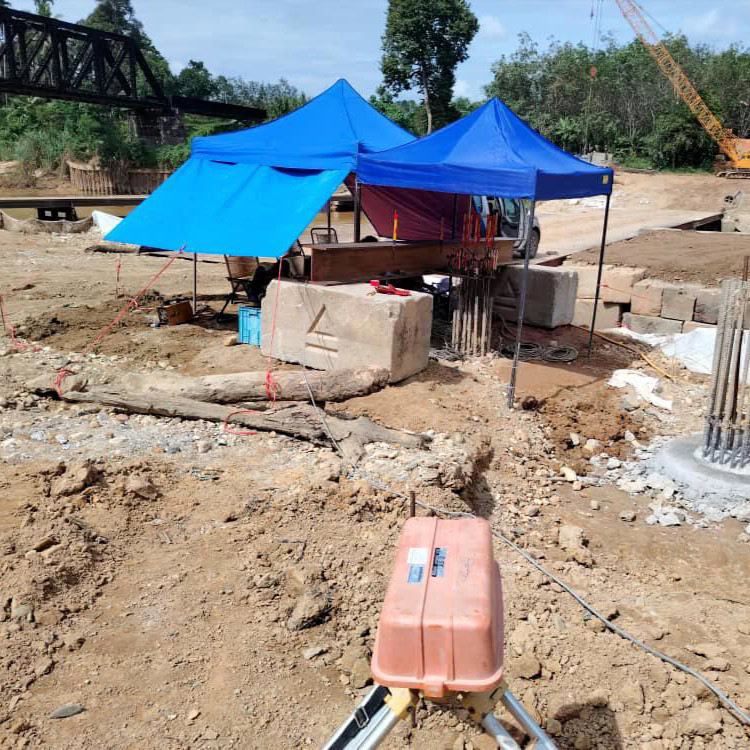
Instrumented Bi-Directional Static Load Test (BDSLT)
Bi-Directional Static Load Testing is an advanced pile testing method used to evaluate pile capacity and load transfer behaviour using an embedded hydraulic loading system. The test applies load internally within the pile, eliminating the need for external reaction systems.
This method provides a reliable and efficient solution for assessing pile performance, particularly for high capacity foundations. It is applicable to various pile types, including bored piles, micropiles, and spun piles.
Testing Principles
The test is conducted using a bi-directional jack installed within the pile. During testing, the jack expands to apply force in two directions:
• Upward force resisted by shaft friction
• Downward force resisted by shaft friction and end bearing
Instrumentation Capabilities
We integrate advanced monitoring systems into the test, including:
• Strain measurement – DFOS and/or VWSG
• Displacement measurement – Extensometer
• Load measurement – Pressure Gauge & Pressure Transducer
This enables accurate measurement of strain distribution, load transfer, and pile response throughout the test.
Customized Bi-Directional Jack
The bi-directional jack system is customized based on pile size and required test load. This ensures optimal performance, accurate load application, and compatibility with different pile types such as bored piles, micropiles, and spun piles.
Advantages Bi-Directional Testing
• No External Reaction System Required
Eliminates the need for kentledge or reaction piles, reducing site space and setup complexity.
• Efficient for High Capacity and Restricted Sites
Suitable for large diameter piles as well as sites with limited working space.
• Reduced Setup Time
Faster installation and testing compared to conventional static load tests.
• Detailed Load Transfer Analysis
Provides clear separation of shaft and base resistance.
• Improved Safety and Cost Efficiency
Minimises heavy equipment and associated site risks.
DFOS Integration (Advanced Solution)
By integrating DFOS, the test provides continuous strain measurement along the entire pile length, enabling comprehensive analysis of pile behaviour under loading.
Key Benefits of DFOS in Bi-Directional Testing
• Full length strain profiling for accurate load transfer evaluation
• Identification of critical zones along the pile
• Higher resolution data compared to conventional sensors